What is a Decentralized Application

In today’s digital age, nearly everyone uses applications (or “apps”) on their smartphones and computers. These apps include everything from social media and messaging to banking and gaming.
What is a decentralized application (dApp) in simple terms?
A decentralized application, or dApp, is an application that runs on a blockchain network rather than being controlled by a single company or central server. This means users can interact directly with the application through smart contracts, giving them greater transparency, security, and control over their data and assets.
Do I need cryptocurrency to use a decentralized application?
You’ll typically need it to pay transaction fees, connect a crypto wallet, or access specific features within the platform. The good news is that these costs are often relatively low, and many newer dApps are becoming more beginner-friendly by reducing fees or covering them entirely to make onboarding easier.
What is a Decentralized Application Overview
- Key Components of a Decentralized Application
- How Do dApps Work?
- Examples of Popular dApps and Their Use Cases
- Advantages and Disadvantages of Decentralized Applications
- Which blockchains can you build dApps on?
- Popular Industries for dApps
- In Conclusion
- Frequently Asked Questions
Key Components of a Decentralized Application
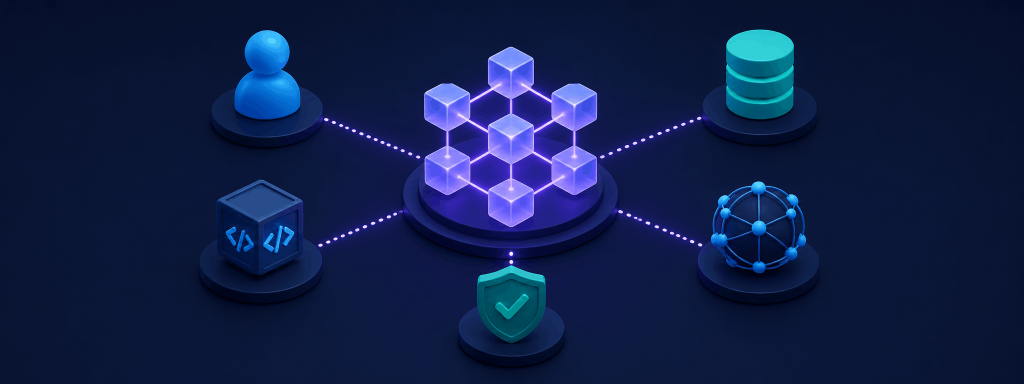
1. Smart Contracts
Think of smart contracts like digital vending machines. When you insert money, the machine automatically gives you the product without any human involvement. In the same way, smart contracts automate tasks within a decentralized application. For example, they can release payments once conditions are met, like confirming a delivery in a supply chain dApp. This automation reduces the need for a middleman, making processes faster and more efficient.
2. Blockchain Network
A blockchain network is like a digital ledger that keeps track of all transactions within a dApp. Imagine a notebook where every person writes down their transactions for everyone to see—once written, it can’t be erased or changed. This transparency ensures trust and accuracy, as no single person can alter the records.
3. Peer-to-Peer Networks
Peer-to-peer networks work like a group chat where each participant stores a copy of the conversation. If one person leaves or loses data, the conversation is still preserved because others have the same copy. This decentralized structure means that even if some nodes go offline, the application continues to run smoothly.
How Do dApps Work?
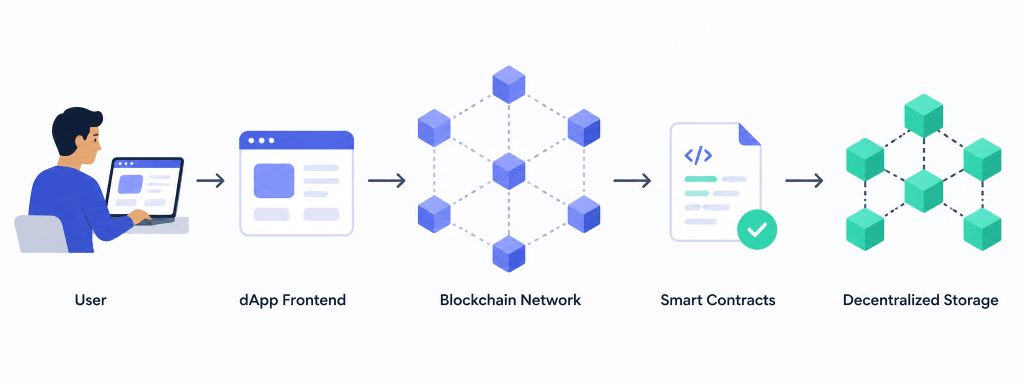
Decentralized applications (dApps) operate differently from traditional apps. Instead of using centralized servers, they run on a network of multiple nodes, which are individual computers that collectively verify and record transactions.
This process relies on distributed ledger technology, similar to how a shared Google Sheet is updated in real time by multiple users, ensuring that every entry is accurate and visible to all.
To process transactions and automate tasks, dApps use cryptographic tokens, digital assets that hold value or represent rights within the application.
For example, some dApps might use tokens as rewards for completing tasks or for voting on app updates. This voting capability is powered by governance tokens, which give holders the right to participate in decision-making processes within the dApp ecosystem.
Take Ethereum-based dApps as an example: the network verifies each transaction using consensus from thousands of nodes.
This structure makes the network 99.99% reliable and highly resistant to manipulation or downtime. As a result, dApps offer higher security and transparency, making them a solid choice for various applications beyond finance.
Examples of Popular dApps and Their Use Cases
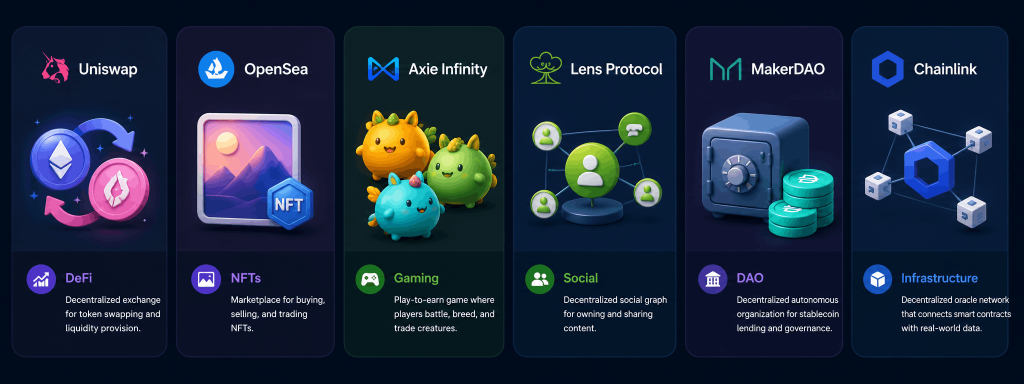
1. Financial Applications
dApps in decentralized finance (DeFi) allow users to borrow, lend, and earn interest on digital assets without relying on traditional banks. For instance, Uniswap, a popular DeFi dApp, facilitates over $1 billion in daily financial transactions, enabling users to trade cryptocurrencies directly with each other.
2. Social Media Platforms
Decentralized social media platforms like Steemit reward users with tokens for creating and curating content. Unlike traditional platforms that store data on centralized servers, these dApps distribute user content across multiple nodes. This reduces censorship and ensures that users control their own data.
3. Supply Chain Management
In supply chain dApps like VeChain, every step of a product’s journey—from production to delivery—is recorded on the blockchain. This tracking mechanism reduces reliance on a central authority and improves transparency. For example, a food company can prove the origin of its products with 100% accuracy, reducing fraud and ensuring product quality.
Advantages and Disadvantages of Decentralized Applications
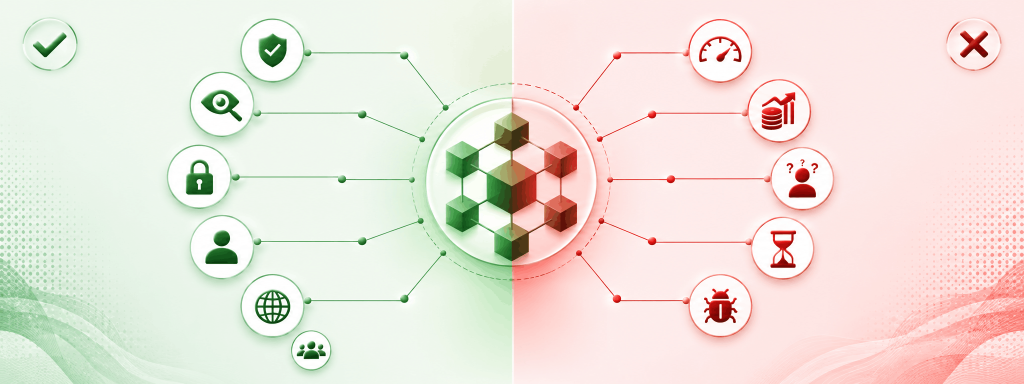
Advantages of Decentralized Applications
1. Transparency
Since dApps are built on the blockchain, their code is essentially transparent.
Practically, anyone can look under the hood and read the code of the dApps they are using.
Unlike applications like Facebook or Google, which are hidden and controlled, you can look at the dApps code and see how the nuts and bolts work.
2. No Downtime
You may have experienced not being able to log into your banking app because they are doing routine monthly or quarterly maintenance.
You may have seen Facebook or Instagram suddenly not loading new posts from time to time.
Applications and programs are susceptible to going offline due to maintenance, and in extreme cases, they might even close down permanently.
You will never experience this with dApps because they are built on the blockchain.
Thousands of computers all around the world that make up the blockchain network would first need to go offline before this happens.
Realistically, it would be virtually impossible to take down all of these computers.
3. Autonomy and Censorship Resistance
dApps are also resistant to control by outside factors. Since they are decentralized, no government or powerful institution can close them down.
Just recently, we have seen China take down gaming companies and other innovative tech companies, along with their billionaire owners.
We have also seen the overprinting of money by the US Federal Reserve, with the help of the US Department of the Treasury, resulting in an inflationary environment in the country.
The US dollar has been losing value continuously because of this. We also see the major social media networks, like Facebook and Twitter, banning controversial people outright, without due process.
Disadvantages of Decentralized Applications
1. Network Congestion
High usage can overwhelm a blockchain network, causing slow transaction times and increased fees. For example, during peak usage periods on the Ethereum network, transaction costs can soar by up to 200%, making simple actions like token transfers expensive and time-consuming.
2. Risk of dApp Scams
The lack of regulation makes some dApps vulnerable to scams and Ponzi schemes. For instance, in 2021 alone, over $2 billion was lost due to fraudulent DeFi projects. Users should be cautious and conduct thorough research before using unfamiliar dApps.
3. Complexity and Usability
Unlike conventional apps, dApps require users to have a basic understanding of blockchain technology. Setting up a crypto wallet and managing private keys can be challenging for beginners, resulting in a higher barrier to entry. This complexity can limit widespread adoption among mainstream users who are used to simpler app interfaces.
Which blockchains can you build dApps on?
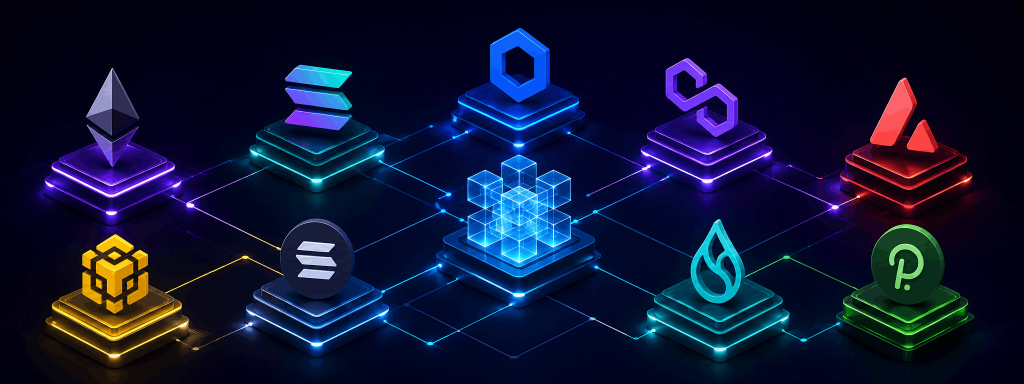
Choosing the best blockchain platform depends on your project’s requirements. Ethereum is the go-to choice if you need a trusted and extensive ecosystem. For scalable solutions, consider Polygon or Arbitrum.
If you need high transaction throughput and security, newer networks like Aptos or Sui might be more suitable.
6 Best Blockchain Platforms for dApp Development
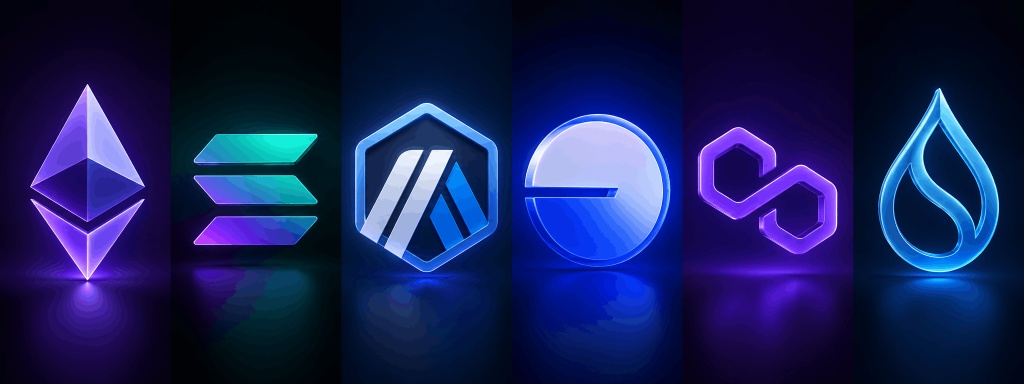
| Feature | Ethereum | Solana | Arbitrum | Base | Polygon | Sui |
| Blockchain Type | Layer-1 | Layer-1 | Ethereum Layer-2 | Ethereum Layer-2 | Ethereum Scaling Ecosystem | Layer-1 |
| Launch Year | 2015 | 2020 | 2021 | 2023 | 2020 | 2023 |
| Native Token | ETH | SOL | ARB | ETH | POL | SUI |
| Transaction Speed (TPS) | ~15–30 | Up to 65,000+ | Thousands (via rollups) | Thousands (via rollups) | Thousands | Up to 297,000 (theoretical) |
| Average Transaction Fees | High during congestion | Very low | Low | Low | Very low | Very low |
| Smart Contract Language | Solidity | Rust, C, C++ | Solidity | Solidity | Solidity | Move |
| Security | Very High | High | Inherits Ethereum security | Inherits Ethereum security | Strong, Ethereum-connected | High |
| Scalability | Moderate | High | High | High | High | Very High |
| Best For | DeFi, NFTs, enterprise applications | High-speed consumer apps, DeFi, gaming | Cost-effective Ethereum dApps | Consumer-focused dApps and onboarding | Scalable Ethereum applications | Gaming, high-performance dApps |
| Main Advantage | Largest ecosystem and developer support | Fast transactions and low fees | Ethereum security with lower costs | Backed by Coinbase and easy onboarding | Low-cost Ethereum compatibility | High throughput and scalability |
| Main Drawback | High gas fees | More centralized validator structure | Depends on Ethereum | Smaller ecosystem than Arbitrum | Faces strong Layer-2 competition | Smaller ecosystem than Ethereum and Solana |
1. Ethereum:
Ethereum remains the go-to blockchain for developers thanks to its massive ecosystem, strong security, and extensive range of decentralized applications.
2. Solana:
Solana is known for its lightning-fast transaction speeds and low fees, making it a popular choice for DeFi, gaming, and consumer-focused dApps.
3. Arbitrum:
Arbitrum helps developers build on Ethereum while benefiting from faster transactions and significantly lower costs.
4. Base:
Backed by Coinbase, Base makes it easier for developers and everyday users to access decentralized applications through a simple and scalable Ethereum Layer-2 network.
5. Polygon:
Polygon enhances Ethereum’s capabilities by offering faster transactions, lower fees, and a developer-friendly environment for building scalable dApps.
6. Sui:
Sui is a high-performance blockchain designed to support next-generation applications that require speed, scalability, and a smooth user experience.
Popular Industries for dApps
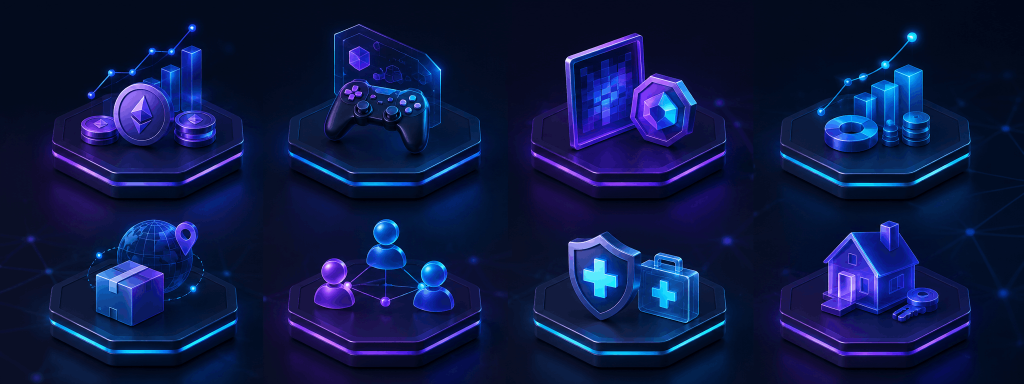
With the emergence of dApps in the blockchain, several industries have sprouted up as well. Here are the top three most popular industries that are thriving in the blockchain:
NFT Marketplace dApps
You may have heard of NFTs or “non-fungible tokens” in the news, as they have surged in popularity this year. NFTs have entered pop culture, with art leading the way. These NFTs are bought and sold in what we call NFT Marketplace dApps. These are simply marketplaces where you can buy, sell, create, and mint NFTs. The most popular NFT marketplaces are OpenSea and Rarible.
dApps
Decentralized Finance dApps have also emerged as a popular industry today. These dApps have created an entirely new digital and decentralized banking ecosystem in the blockchain. You can borrow, lend, and stake your crypto using these platforms. You can become a provider of liquidity to liquidity pools, which is a way to earn interest, or you can simply invest and trade in various cryptocurrencies in decentralized exchanges (DEXs).
Gaming dApps
You may have heard of the sudden popularity of the game Axie Infinity. It is an NFT-based play-to-earn game where you can earn cryptocurrency by just playing the game. This is also a smart contract dApp, which is NFT-based but with a gaming utility.
Similar games such as Cryptokitties, Splinterlands, Alienworlds, and Mobox have risen to popularity, especially during the pandemic, when people were mostly in front of their laptops and PCs. Gaming dApps are a fun way to experience both blockchain technology and cryptocurrency.
In Conclusion
Decentralized applications are changing the way people interact with digital services by removing the need for a central authority.
Instead of relying on a company to manage data, transactions, or access, dApps use blockchain technology and smart contracts to give users more control, transparency, and security.
Frequently Asked Questions
What is a Decentralized Application?
A decentralized application (dApp) is a software program that operates on a decentralized network of computers rather than a single server. It utilizes smart contracts and blockchain technology to enable peer-to-peer interactions without a central authority controlling the data.
What are the Advantages of dApps Over Centralized Applications?
dApps provide increased security and data integrity by eliminating the risks associated with a single point of failure. Since they run on distributed networks, they are resistant to censorship, making them ideal for applications where transparency and user control are crucial.
What is the Role of Smart Contracts in dApps?
Smart contracts are automated agreements coded directly onto the blockchain. They self-execute when conditions are met, enabling dApps to perform tasks like financial transactions and data verification without human intervention. This reduces the need for intermediaries and lowers transaction costs.
How Do I Use a Decentralized Application?
Using a dApp is usually as simple as connecting a compatible crypto wallet, such as MetaMask or Trust Wallet, and interacting with the platform through your web browser or mobile device. Depending on the dApp, you may need cryptocurrency to pay transaction fees or access certain features.
Are Decentralized Applications Safe to Use?
dApps can be very secure because they run on blockchain networks and use smart contracts. However, users should still be cautious, as poorly written smart contracts, phishing scams, and fake dApps can pose risks. It’s always best to use trusted platforms and do your own research.
Do I Need Cryptocurrency to Use a dApp?
In many cases, yes. Most dApps require cryptocurrency to pay network fees, connect a wallet, or complete transactions. The amount needed is often small, and some platforms are working to make the process easier for newcomers.
What Types of Decentralized Applications Exist?
dApps can be found across many industries, including decentralized finance (DeFi), gaming, NFT marketplaces, social media, digital identity, and online marketplaces. Their flexibility allows developers to create alternatives to many traditional online services.
Can Anyone Build a Decentralized Application?
Yes. Developers can build dApps using blockchain platforms such as Ethereum, Solana, Polygon, and Sui. With the right programming skills and blockchain knowledge, anyone can create a decentralized application and make it available to users worldwide.
What is the Difference Between a dApp and a Traditional App?
A traditional app is usually controlled by a company that manages its servers, data, and operations. A dApp, on the other hand, runs on a decentralized blockchain network, giving users greater transparency and reducing reliance on a central authority.
Why Are Decentralized Applications Becoming Popular?
dApps are gaining popularity because they offer greater transparency, security, and user control than many traditional applications. As more people become interested in blockchain technology and digital ownership, decentralized applications continue to attract users and developers across a wide range of industries.
 ABOUT THE AUTHOR
See More
ABOUT THE AUTHOR
See More


Sidebar rates

